Loading...
Loading...

Loading...
Section 01 · Stage 1: Learn Python
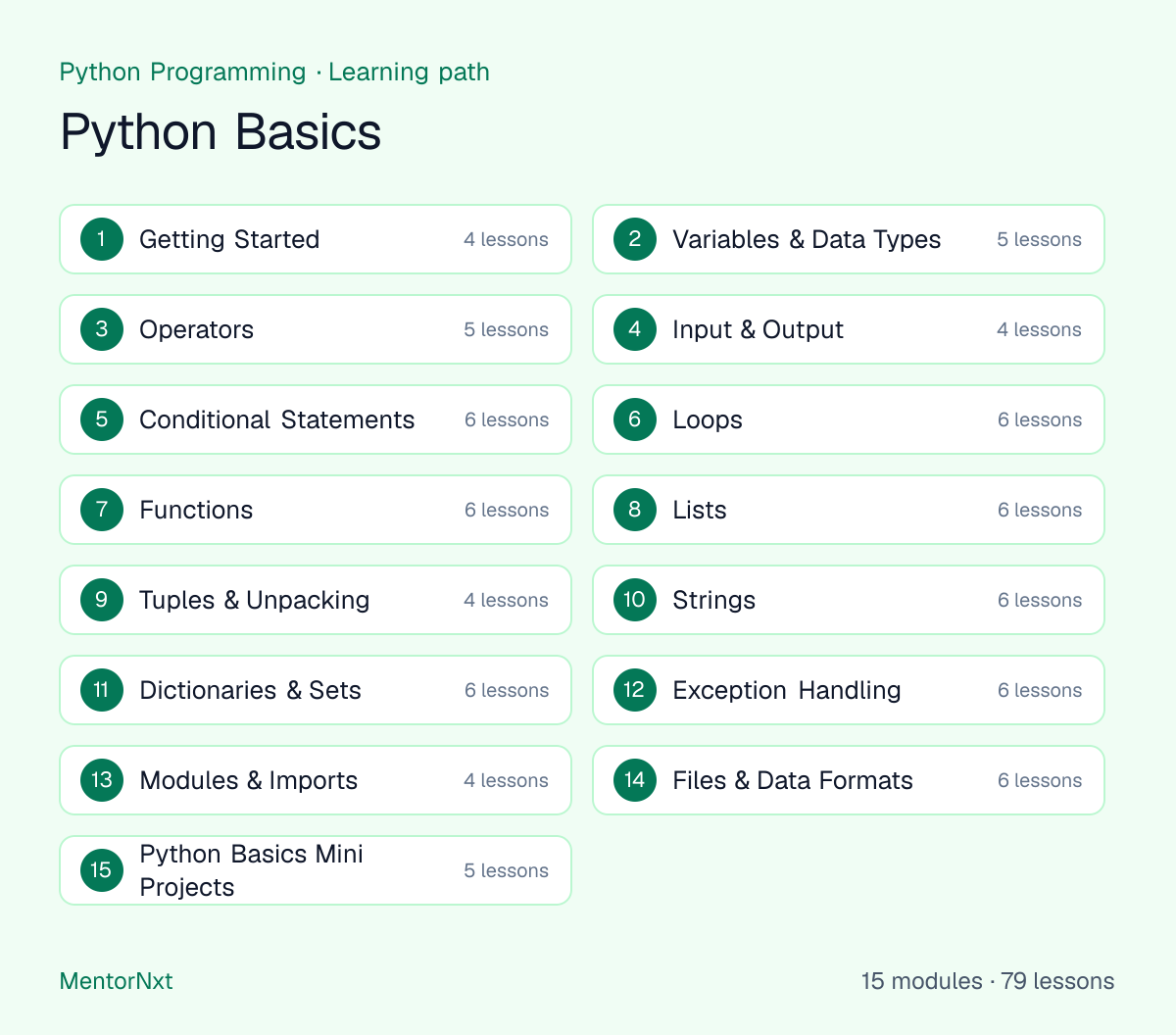
Your first programs: variables, conditions, loops, functions, lists, strings and errors.
What Python is, how the Python interpreter runs code, installing Python 3, setting up VS Code, and running your first program.
Understand Python's name-binding model, dynamic typing, arbitrary-precision integers, floats, strings, booleans, casting, and None.
Master arithmetic operators, true division vs floor division, compound assignment, chained comparisons, and short-circuit logical operators.
Print data with custom separators (sep) and line endings (end), build f-strings with format specifiers, and read user input with input().
Branching with if and if-else, multi-way branching with elif, ternary expressions, and Python 3.10+ match-case structural pattern matching.
Master while loops, sequence iteration with for and range(), break/continue, the unique Python loop-else clause, and nested loops.
Define modular functions with def, pass positional and keyword arguments, default parameters, *args, **kwargs, LEGB scope, and lambdas.
Master Python's dynamic array: creation, 0-based and negative indexing, slicing [start:stop:step], list methods (append, pop, sort), comprehensions, and nested matrices.
Group values that should not change, split them into separate names, swap values in one line, and use tuples with functions, zip and enumerate.
Unicode strings in Python: indexing and slicing, essential transformation methods (strip, lower, upper, replace), search/validation, and split/join.
Master Python's built-in hash tables: key-value dictionaries, safe lookups with .get(), dict comprehensions, unique sets, and mathematical set algebra.
Master robust error handling in Python: understand tracebacks, handle runtime errors with try and except, manage cleanup with else and finally, and raise custom exception classes.
Use import, from and as with math, random and datetime, write your own module with the main guard, and install packages with pip.
Read and write text files, handle paths and missing files, and work with CSV and JSON data.
Put Python Basics together across five comprehensive real-world projects: an e-commerce cart, server log telemetry analyzer, crypto portfolio tracker, password security auditor, and warehouse inventory manager.